




In a city that gets as much snow as Saint John, NB, it's easy to assume winter is the busy season. Furnaces quit, pipes freeze, cars end up in ditches, and the phones should be ringing.
We pulled a year of Google search data for New Brunswick, Canada to check. For most trades, it isn't true. Winter doesn't bring most local businesses more work. It brings roughly the same work under worse conditions, and that's a different problem to plan for.
What the search data shows
The charts below come from Google Trends and cover all of New Brunswick, Canada from October 2025 to October 2026. Each one is scaled from 0 to 100 against its own busiest point, so they show when people search, not how many. For volume we used Google's Keyword Planner, which puts most of these terms at 100 to 1,000 searches a month across the province.
Auto repair

The busiest month for auto repair searches is July. The quietest are December and January, about 40% below the summer high. People drive more in summer, and in winter they put off anything that isn't urgent.
Towing

Towing is the biggest term in the set, at 1,000 to 10,000 searches a month, and one of the flattest. It runs between about 70 and 100 all year with two near-equal high points, one in late winter and one in late summer. Neither is much above the rest of the year.
Plumber

Plumbing searches sit between about 65 and 95 all year and are highest in spring, around May. Frozen pipes happen, but they don't show up as a winter surge.
Snow removal

This is the one that behaves the way you'd expect, and the clearest seasonal curve in the set. Searches climb through the fall, peak in December, and fall to nothing by April. The climb starts well before the first storm.
Oil delivery

One sharp peak in late winter, centred on February, and almost nothing the rest of the year. The volume is small, 10 to 100 searches a month across the province, so most of this business runs on existing customers rather than search.
Furnace repair, for what it's worth, barely registers at all: 10 to 100 searches a month, too few for Google Trends to chart. People with a broken furnace mostly call someone they already know.
Retail and food
The Christmas trade is real. The search data just puts it in a different place than most owners expect.
Gift shops
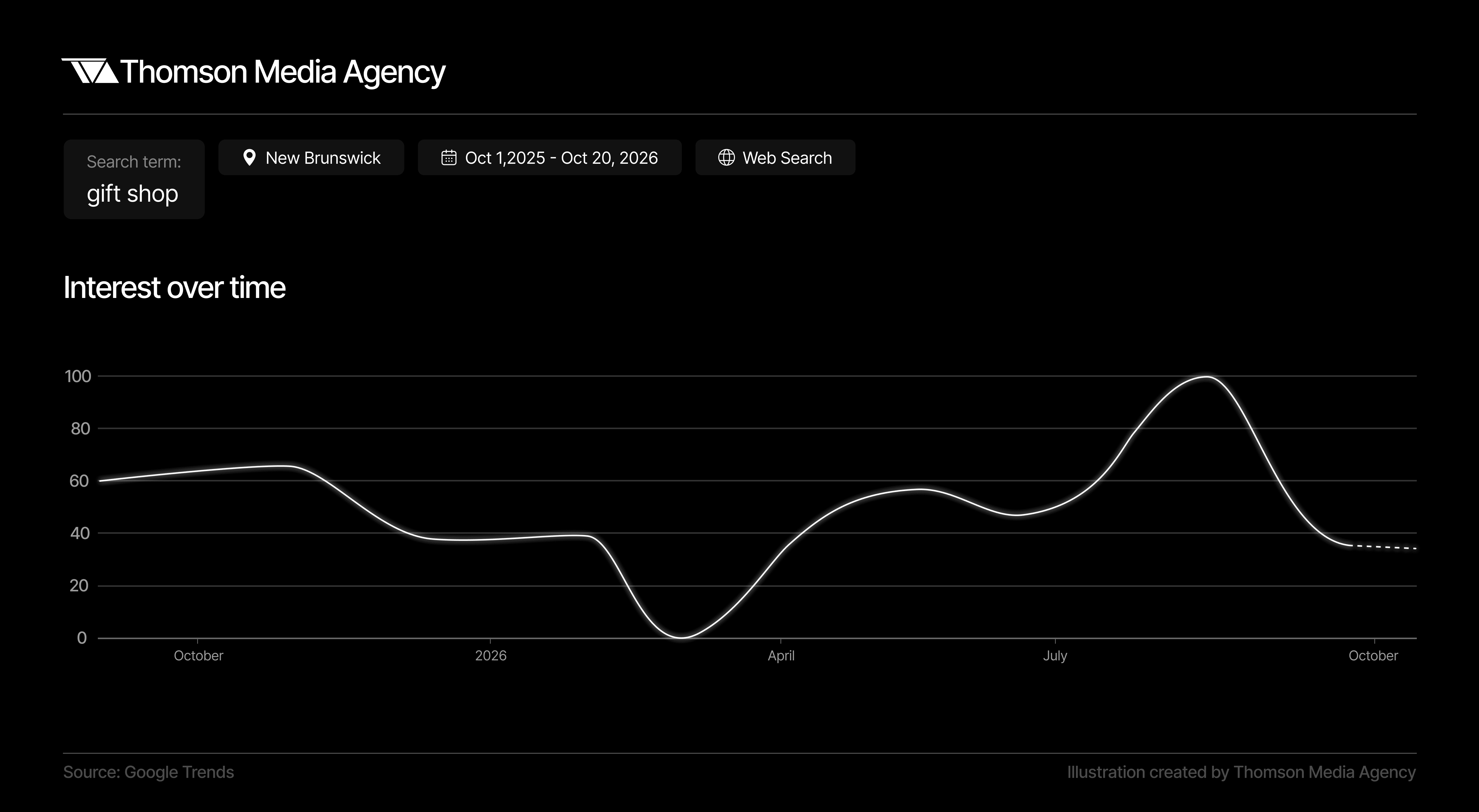
Gift shop searches lift a little in November, then sink and hit their lowest point of the year in late winter. But the biggest peak isn't Christmas at all. It's August, which lines up with the summer tourist season.
Restaurants
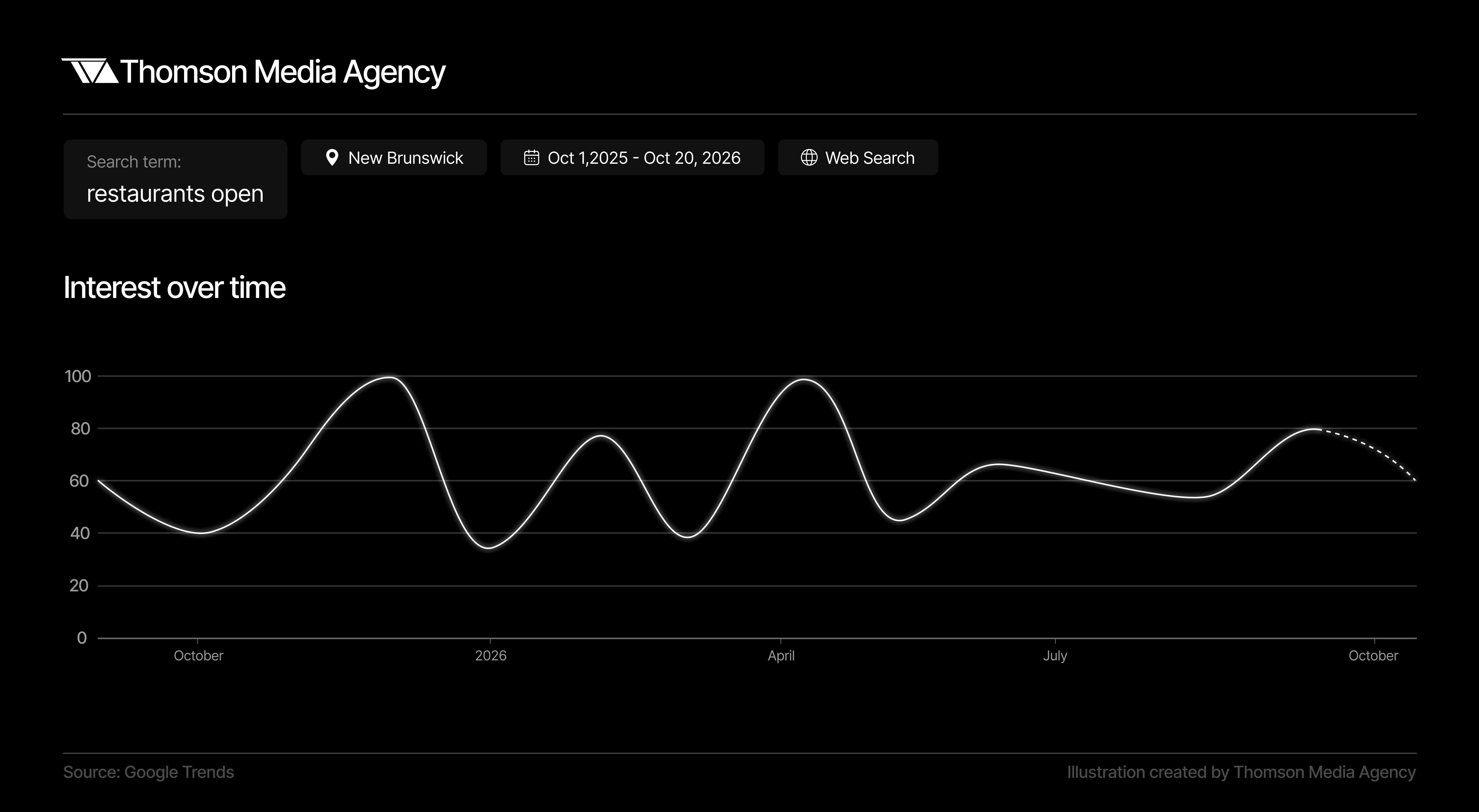
Searches for restaurants that are open peak in December and drop to one of their lowest points of the year in early January, then jump around for the rest of the year. The December high is holiday dinners and people checking who's open on odd days. The January low is the hangover.
For both, the lesson is the one the trades teach too: the slow months after the holidays are steeper than they feel in December, and they're easier to plan for before you're in them.
So what actually changes
If the volume mostly holds steady, what changes in winter is the conditions the same customers are searching in.
Storm closures nobody announces. A business shuts for a storm day and its Google profile still says open. Someone calls, gets no answer, and doesn't try again.
Hours that were right in August. Winter hours, holiday hours, the early close on Christmas Eve. If they aren't on your profile, Google shows the old ones, and people trust what Google shows.
Calls that go unanswered. The plumber is under a sink. The owner is out clearing the lot. In winter a call that rings out usually means the customer has already dialled the next business on the list.
People deciding from a phone, indoors. In bad weather people search from the couch and pick whoever looks open and easy to reach. Being listed isn't enough. Looking current is what wins the call.
None of that shows up in a search chart. All of it decides who gets the work.
What to change before December

None of this is expensive. Most of it is an hour's work, done once, before the first storm.
1. Put holiday and storm-day hours on your Google profile. Google Business Profile lets you set special hours for specific dates, including marking a day closed. Add the holidays now. Then get in the habit of updating it the morning of a storm day. It takes a minute from the phone app.
2. Decide what happens to a call you miss. A full voicemail or a call that rings out loses the job. A text back within a minute, something like "Sorry we missed you, we're on a job, we'll call back by 3," keeps most people from calling someone else. It's one of the things we set up for service businesses in Saint John, NB, but any phone system that sends an automatic text back will do.
3. Let people book or order without talking to anyone. An online booking link, an order form, or even a simple enquiry form that lands somewhere you actually check. When you can't pick up the phone, it can still take the job.
4. Pick one place you tell people you're closed. Your Google profile first, then a pinned post on Facebook or a banner on your website. Whatever you choose, make sure they all say the same thing on the same day.
5. Add winter photos. Most local profiles show the building in summer sunshine. A cleared lot, your truck in the snow, or the shop lit up in December tells people you're open now, not just in July.
If your website can't handle bookings or a closure notice, our guide to what a small business website costs in New Brunswick, Canada covers the options, including the cheap ones.
The short version
Before December:
Holiday hours added to your Google Business Profile
A habit of posting storm-day closures the same morning
Missed calls get an automatic text back
Customers can book, order or enquire without phoning
One place you announce closures, with your profile, website and social all matching
At least three winter photos on your profile
Winter in Saint John, NB won't send most businesses a flood of new work. It'll send the same customers as July, searching from home in the snow, and the business that looks open and picks up is the one they'll call.
In a city that gets as much snow as Saint John, NB, it's easy to assume winter is the busy season. Furnaces quit, pipes freeze, cars end up in ditches, and the phones should be ringing.
We pulled a year of Google search data for New Brunswick, Canada to check. For most trades, it isn't true. Winter doesn't bring most local businesses more work. It brings roughly the same work under worse conditions, and that's a different problem to plan for.
What the search data shows
The charts below come from Google Trends and cover all of New Brunswick, Canada from October 2025 to October 2026. Each one is scaled from 0 to 100 against its own busiest point, so they show when people search, not how many. For volume we used Google's Keyword Planner, which puts most of these terms at 100 to 1,000 searches a month across the province.
Auto repair
The busiest month for auto repair searches is July. The quietest are December and January, about 40% below the summer high. People drive more in summer, and in winter they put off anything that isn't urgent.
Towing
Towing is the biggest term in the set, at 1,000 to 10,000 searches a month, and one of the flattest. It runs between about 70 and 100 all year with two near-equal high points, one in late winter and one in late summer. Neither is much above the rest of the year.
Plumber
Plumbing searches sit between about 65 and 95 all year and are highest in spring, around May. Frozen pipes happen, but they don't show up as a winter surge.
Snow removal
This is the one that behaves the way you'd expect, and the clearest seasonal curve in the set. Searches climb through the fall, peak in December, and fall to nothing by April. The climb starts well before the first storm.
Oil delivery
One sharp peak in late winter, centred on February, and almost nothing the rest of the year. The volume is small, 10 to 100 searches a month across the province, so most of this business runs on existing customers rather than search.
Furnace repair, for what it's worth, barely registers at all: 10 to 100 searches a month, too few for Google Trends to chart. People with a broken furnace mostly call someone they already know.
Retail and food
The Christmas trade is real. The search data just puts it in a different place than most owners expect.
Gift shops
Gift shop searches lift a little in November, then sink and hit their lowest point of the year in late winter. But the biggest peak isn't Christmas at all. It's August, which lines up with the summer tourist season.
Restaurants
Searches for restaurants that are open peak in December and drop to one of their lowest points of the year in early January, then jump around for the rest of the year. The December high is holiday dinners and people checking who's open on odd days. The January low is the hangover.
For both, the lesson is the one the trades teach too: the slow months after the holidays are steeper than they feel in December, and they're easier to plan for before you're in them.
So what actually changes
If the volume mostly holds steady, what changes in winter is the conditions the same customers are searching in.
Storm closures nobody announces. A business shuts for a storm day and its Google profile still says open. Someone calls, gets no answer, and doesn't try again.
Hours that were right in August. Winter hours, holiday hours, the early close on Christmas Eve. If they aren't on your profile, Google shows the old ones, and people trust what Google shows.
Calls that go unanswered. The plumber is under a sink. The owner is out clearing the lot. In winter a call that rings out usually means the customer has already dialled the next business on the list.
People deciding from a phone, indoors. In bad weather people search from the couch and pick whoever looks open and easy to reach. Being listed isn't enough. Looking current is what wins the call.
None of that shows up in a search chart. All of it decides who gets the work.
What to change before December
None of this is expensive. Most of it is an hour's work, done once, before the first storm.
1. Put holiday and storm-day hours on your Google profile. Google Business Profile lets you set special hours for specific dates, including marking a day closed. Add the holidays now. Then get in the habit of updating it the morning of a storm day. It takes a minute from the phone app.
2. Decide what happens to a call you miss. A full voicemail or a call that rings out loses the job. A text back within a minute, something like "Sorry we missed you, we're on a job, we'll call back by 3," keeps most people from calling someone else. It's one of the things we set up for service businesses in Saint John, NB, but any phone system that sends an automatic text back will do.
3. Let people book or order without talking to anyone. An online booking link, an order form, or even a simple enquiry form that lands somewhere you actually check. When you can't pick up the phone, it can still take the job.
4. Pick one place you tell people you're closed. Your Google profile first, then a pinned post on Facebook or a banner on your website. Whatever you choose, make sure they all say the same thing on the same day.
5. Add winter photos. Most local profiles show the building in summer sunshine. A cleared lot, your truck in the snow, or the shop lit up in December tells people you're open now, not just in July.
If your website can't handle bookings or a closure notice, our guide to what a small business website costs in New Brunswick, Canada covers the options, including the cheap ones.
The short version
Before December:
Holiday hours added to your Google Business Profile
A habit of posting storm-day closures the same morning
Missed calls get an automatic text back
Customers can book, order or enquire without phoning
One place you announce closures, with your profile, website and social all matching
At least three winter photos on your profile
Winter in Saint John, NB won't send most businesses a flood of new work. It'll send the same customers as July, searching from home in the snow, and the business that looks open and picks up is the one they'll call.